15T vs Larger Underground Trucks: Haulage Payload Guide | DALI
Why Does Payload Choice Matter in Underground Haulage?
Picking a 15T underground truck, a 20 ton underground truck, or a 30 ton underground truck is more than a simple payload question. Inside a real mine, the best pick is different. It is the truck that moves dirt smoothly through your dark tunnel. It needs to match your loader well. It must climb your ramp safely. Also, it must keep your cost per ton low.
Payload Is Only One Part of the Job
A bigger underground mining truck holds more dirt in a single trip. But, it might not finish more work during the day. Sometimes, your mine tunnel size is quite small. Then, a huge underground dump truck will slow down at every tight corner. It will wait longer at passing bays and loading spots. A compact 15 ton underground truck often does a better job in a narrow mine tunnel. It turns fast. Thus, it spends way less time just waiting around.
Bigger Trucks Need Bigger Mine Conditions
A 30 ton underground truck demands wider tunnel dimensions. It needs very strong dirt roads and big loading bays. It also needs high ore output to stay completely full. Suppose the truck runs half-empty. Then, things get bad. The fuel burn goes up fast. Tires wear out quicker. The air fan costs and fix-up bills climb high. All these things push your underground mining truck cost per ton way up.
When Is a 15T Underground Truck the Better Choice?
A 15T underground truck is mostly the smartest pick when your rock space is tight. It works great if the haul distance is short or medium. Also, your daily dirt target might not need a massive truck fleet. Plus, it fits very well with smaller LHD loader models in many work zones.
Narrow Tunnel Work Needs a Smaller Turning Radius
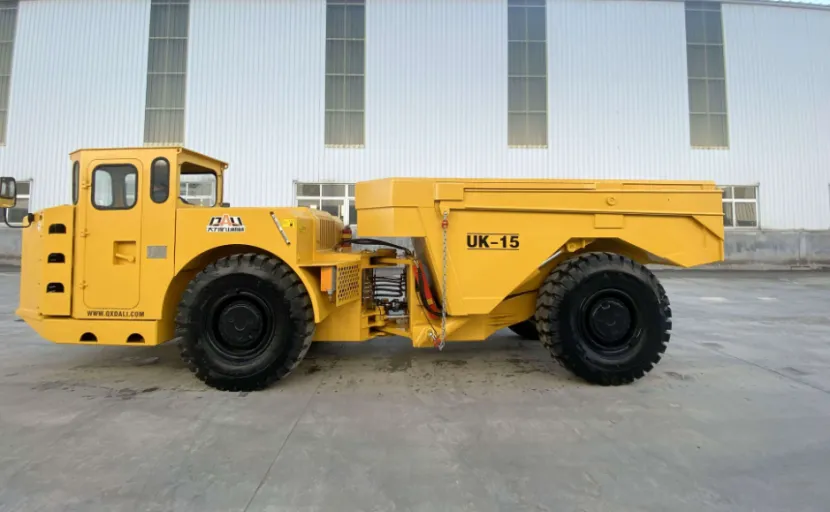
DALI’s 15T Underground Truck is made for tight underground mines. It has a 15,000 kg loading capacity. It uses a 7.5 m³ bucket. It features center-articulated frames. It also has a nice 45° steering angle.
This tiny turning radius helps a lot in any squeezed underground space. Losing a few seconds at every bend is bad. It can ruin your whole day. The stated turning radius is 3500 / 6100 mm. Its travel speed goes from 0–23 km/h.
Short Haul Distance Can Favor More Cycles
For short haul distance, hauling speed comes from fast loading. It comes from quick driving and smooth dumping. It does not just come from maximum mining truck payload capacity. A 15T underground truck can do more haulage cycle rounds. Meanwhile, a larger underground haulage truck would waste time needing extra room just to turn.
When Should You Move up to 20T or 30T?
Heavier payloads make sense when your mine is truly ready for them. The main rule is not “bigger means stronger.” The real test is different. Can the big truck stay fully loaded? Can it drive safely? Will it drop the cost per ton across the whole haul route?
A 20 Ton Underground Truck Fits Medium Production
A 20 ton underground truck is often a solid middle pick for underground mining truck selection. It fits a mine having medium tunnel width. The dirt roads must be stable. The haul distance should be average.
Also, there must be enough ore output to keep the truck busy. You pick it when a 15T underground truck needs too many trips. But, a 30 ton underground truck feels too massive for the drift.
A 30 Ton Underground Truck Needs High Output
A 30 ton underground truck shines in giant mines. These places have a long haul distance. They have wide ramps. They also boast a huge daily production target. It really cuts down total trips.
If the underground ramp gradient is very steep, be careful. If the rocky road is rough, you must check the brakes. Good traction and safe loaded downhill travel are a must.
How Do Mine Tunnel Size and Ramp Gradient Affect Truck Selection?
Truck size is super real underground. A huge machine might look great on a paper flyer. Then, it feels entirely too fat at a tight rock point. That is exactly why you must check tunnel dimensions first. Look at your underground tunnel width. Check the turning radius and ramp design. Do all this before you buy.
Tight Tunnels Favor Compact Underground Trucks
For narrow mine tunnel work, compare a small underground truck vs large underground truck. The smaller unit usually wins. It has less body width. Steering is a breeze. The driver can see better. This makes safe underground haulage much easier. A huge truck might force you to dig wider tunnels. That digging cost is very easy to forget.
Steep Ramps Increase Stress on the Truck
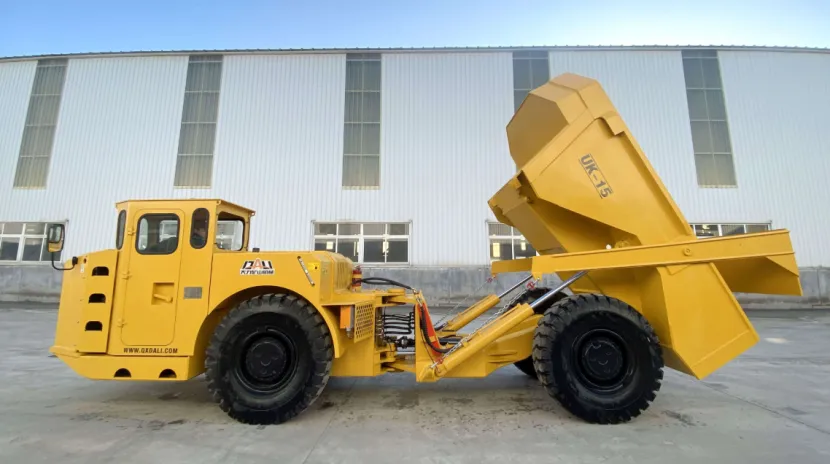
DALI’s 15T model lists a nice 20° climbing ability. It has 180 kN traction. It uses a spring brake with a hydraulic release. It also puts in a purification silencer system. This part cuts down bad air and loud noise in the working tunnel. These facts matter a lot. The underground ramp gradient pushes power demand hard. It heats up the brakes. It stresses the air fans. It also affects the driver’s peace of mind.
How Should You Match the Truck With Loading Equipment?
Loading equipment dictates your flow. It decides if your truck waits, runs half-empty, or moves fast. In everyday work, loader-truck matching is where lots of mines lose precious time. Sometimes they lose it very quietly.
Check Loader Bucket Capacity First
For truck and loader matching, look at the loader bucket capacity. Compare it with the dump box capacity and the heavy dirt density. A 15T underground truck must fill up in a few sensible loader passes. Too many loader passes ruin your loading cycle time. Too few passes might overload the truck. It might even spill rocks everywhere.
Match the Whole Fleet, Not One Machine
Your underground loader, underground haulage truck, and rock dumping point must act as one single team. Say the LHD loader is too tiny for a 30 ton underground truck. The truck will sit and wait way too long. Say the loader is too huge for a 15T underground truck. Then, overloading becomes a huge daily danger.
Why Choose DALI for Underground Mining Equipment?
DALI is a mining equipment manufacturer located in Yantai, China. We started back in 1998. Our factory spans 130,000 square meters. We have over 200 workers. About 90 of our team members are smart technicians and engineers. Our brand covers underground mine equipment and ore processing equipment. We provide spare parts, setup, teaching, and EPCM services. This covers non-ferrous, ferrous, and non-metallic mines.
The underground equipment group has scooptrams, mining trucks, and mine locomotives. They also make mobile rock splitters, scalers, and utility vehicles. This gear runs in over 900 mines. The brand has built over 500 mine processing plants. This gives buyers a much stronger help base than a one-machine shop.
How Can You Choose the Right Payload for Underground Haulage?
Start looking at your actual mine. Do not just read a sales catalog. Write down your real mine tunnel size. Jot down your haul distance and ore output. Note the underground ramp gradient. Check your loading equipment. Write down your goal cost per ton. Next, look at the 15T 20T 30T underground truck comparison data. Match that data to your dirt road.
A Simple Selection Rule
Pick a 15T underground truck when rock space is tight. Use it when cycle time matters most. Pick 20T when the mine shows medium output. Use it in nicer tunnel conditions. Pick 30T when the mine shows massive ore output. It needs a long haul distance. You need larger loading equipment. You also need tons of safe room to drive.
FAQ
Q1: Is a 15T underground truck suitable for narrow mine tunnels?
A: Yes. A 15T underground truck is a great fit for narrow mine tunnel work. The compact body size helps. The smaller turning radius cuts down long waits and hard steering.
Q2: When should you choose a 20 ton underground truck?
A: Pick a 20 ton underground truck when your ore output is big. It works if a 15T fleet cannot keep up. But, your tunnel dimensions cannot fit massive 30T trucks.
Q3: Is a 30 ton underground truck always more efficient?
A: No. A 30 ton underground truck only saves money when it stays fully filled. It needs nice roads, gentle ramps, and a long haul distance.
Q4: How do you match an underground truck with an LHD loader?
A: Look at the loader bucket capacity. Check the loader passes and loading cycle time. Also view the dump box capacity and ore density. The truck must load fast without carrying too much.
Q5: What factors affect underground mining truck selection most?
A: The top things are mine tunnel size, haul distance, and ore output. You also check underground ramp gradient, loading equipment, turning radius, fuel burn, and total cost of ownership.
About Us
Qixia Dali Mining Machinery Co., Ltd was established in 1998, located in Yantai City.
The company is mainly engaged in the design, development, production, installation and training of underground mine equipment and ore processing equipment, spare parts supply and sales.
More
Contact Us
- Xinbang Rd, Private Economy Park, Qixia, Shandong Province, China
- +86 173 5350 8179
- ytdali@ytdali.com
 +86 13553073459
+86 13553073459
+86 13553073459


