How to Match LHD Payload and Bucket Size to Mine Production Targets
Choosing LHD payload and bucket size is not just a machine question. It is a production question. If the loader is too small, your trucks wait. If it is too large, it may slow down in narrow tunnel operation and raise the risk of ore dilution. Either way, the result is often the same: a missed production target and a higher cost per tonne.
DALI has worked in underground mining equipment since 1998. Based in Yantai, China, the company has a 130,000 square meter factory, more than 200 employees, and 90 technicians and engineers. Its work covers underground vehicles, ore processing equipment, spare parts, installation, training, and EPCM service.
For mine owners and contractors, that background matters because equipment choice rarely stands alone. A loader must match the mine layout, truck fleet, and daily tonnage plan. DALI’s machines serve more than 900 mines, and the company has built more than 500 mine processing plants, so its product data is useful when you need a practical planning base, not just a brochure.
Why Does Payload Matching Matter in Underground Mining?
Payload matching affects every shift. A loader may look strong on paper, but the real question is simple: can it move the right tons, at the right pace, without causing truck waiting time or low loading efficiency?
Payload per Cycle Drives Real Output
Underground LHD payload should be judged by payload per cycle, not only by rated capacity. Each cycle includes loading, tramming, dumping, and returning. If a loader carries less than planned, cycles per hour must rise. That means more fuel, more tire wear, more operator fatigue, and more equipment downtime.
This is why the wrong LHD size becomes expensive. It does not always fail loudly. Sometimes it just loses 20 minutes here, 15 minutes there. By month-end, the gap is real.
What Should You Know Before Calculating LHD Capacity?
Before choosing LHD bucket size, you need several mine inputs. Guessing is risky. Use the real ore body, real drift, and real truck fleet.
Ore Density and Fill Factor Come First
A 3m³ bucket does not always carry the same weight. Ore loose density and bucket fill factor change the effective bucket payload.
A simple formula helps:
Effective bucket payload = bucket size × ore loose density × bucket fill factor
For example, a 3m³ bucket with 2.4 t/m³ ore loose density and a 90% bucket fill factor gives about 6.48 tons. If the ore is 2.6 t/m³, the same bucket gives about 7.02 tons. That is already close to a 7000kg payload. So yes, density matters. A lot.
How Can a 3m³ Bucket and 7000kg Payload Be Used for Planning?
The DALI WJ-3 diesel LHD gives a useful example for LHD capacity planning for underground mines. It is a compact diesel LHD built for narrow vein mining LHD applications.
Use Product Data as a Planning Base
The machine has a 3m³ bucket, 7000kg payload, 165kW engine power, and 9044 × 1980 × 2238mm tramming size. It is suitable for tunnels above 3.4m × 3.4m. It also has remote control available, which helps when the loading area is unsafe or visibility is poor.
For a 3m³ diesel LHD, this balance is practical. It is not just about size. You get a 7000kg payload LHD that can still work in tighter headings where an oversized underground loader may lose time turning or may damage sidewalls.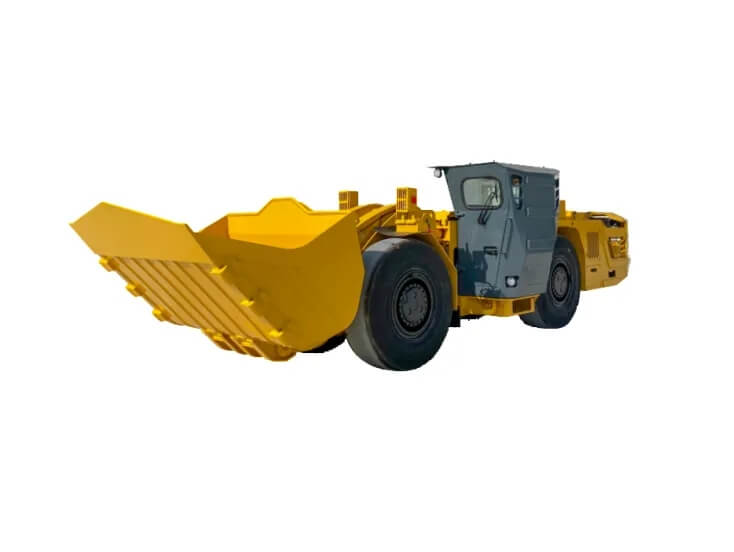
How Do You Calculate Daily Tonnage From LHD Cycle Time?
Daily tonnage calculation links machine data with your actual mine rhythm. This is where planning becomes useful for procurement.
Start With a Simple Field Formula
Use this:
Daily tonnage = payload per cycle × cycles per hour × productive hours per day × equipment availability
Say your effective bucket payload is 6.5 tons. If LHD cycle time is 6 minutes, that gives 10 cycles per hour. With 14 productive hours per day and 85% equipment availability, daily output is:
6.5 × 10 × 14 × 0.85 = 773.5 tons per day
If your mine production targets are around 750 tons per day, one unit may fit. If your target is 1,200 tons per day, one loader may not be enough, unless cycle time drops or working hours increase.
How Should LHD Bucket Size Match Underground Truck Capacity?
LHD truck matching is often where production plans go wrong. The loader and truck must work as one system.
Aim for 3 to 5 Passes per Truck
A common target is 3 to 5 passes per truck. If a truck needs too many passes, loading takes too long. If it fills in one pass, the impact load may be rough and the truck may not match the loader well.
With an effective load near 6.5 tons, a 15-ton underground truck needs about 3 passes. A 20-ton truck needs about 4 passes. A 25-ton truck needs 4 to 5 passes. That is a clean match for many small and medium underground mines.
What Happens if the LHD Is Too Small or Too Large?
The cheapest machine is not always cheaper to run. The biggest machine is not always faster either. Mine production targets need a middle ground.
The Risk Is Hidden in Daily Delays
An undersized LHD means more cycles, more fuel per tonne, and longer truck waiting time. An oversized underground loader can struggle in turns, raise ventilation demand, slow the operator, and increase ore dilution. In narrow vein mining, right-sizing usually beats up-sizing.
Why Does DALI WJ-3 Fit Narrow Vein Production Planning?
If you need a 3m³ LHD for underground mining, the machine should support capacity, maneuverability, safety, and service access together. One strong number is not enough.
A Practical Fit for Controlled Output
The DALI WJ-3 diesel LHD fits mines that want controlled output without buying a machine that is too large for the drift. Its articulated frame, 40° steering angle, four-wheel driving and braking, automatic alarm system, low cab vibration, and rear-frame operator compartment all support steady work. Small detail, but operators care about that after a long shift.
For underground mining equipment selection, ask the hard questions: What is the ore loose density? What bucket fill factor is realistic? How many cycles per hour can your drift support? How many productive hours per day are real, not just planned? That is how to choose LHD bucket size with fewer surprises.
FAQ
Q1: How Do You Calculate LHD Daily Production?
A: Use daily tonnage calculation: payload per cycle × cycles per hour × productive hours per day × equipment availability. This connects LHD cycle time with real mine production targets.
Q2: Is a 3m³ Bucket Enough for Narrow Vein Mining?
A: A 3m³ bucket can be enough when ore loose density, bucket fill factor, haul distance, and underground truck capacity are well matched. It is often practical for a narrow vein mining LHD.
Q3: How Many Passes Should an LHD Take to Fill an Underground Truck?
A: In many underground jobs, 3 to 5 passes per truck is a good target. It keeps LHD truck matching clean and helps control truck waiting time.
Q4: Why Does Ore Density Matter When Choosing LHD Bucket Size?
A: LHD bucket size is measured by volume, but production is measured by tons. High ore loose density may reach rated underground LHD payload before the bucket looks full.
Q5: What Makes DALI WJ-3 Suitable for Production Planning?
A: The DALI WJ-3 diesel LHD offers a 3m³ bucket, 7000kg payload, compact diesel LHD structure, remote control diesel LHD option, and tunnel suitability above 3.4m × 3.4m, making it useful for practical underground mine planning.
About Us
Qixia Dali Mining Machinery Co., Ltd was established in 1998, located in Yantai City.
The company is mainly engaged in the design, development, production, installation and training of underground mine equipment and ore processing equipment, spare parts supply and sales.
More

Contact Us
- Xinbang Rd, Private Economy Park, Qixia, Shandong Province, China
- +86 173 5350 8179
- ytdali@ytdali.com
 +86 13553073459
+86 13553073459
+86 13553073459


