Underground Mining Methods: Matching Methods to the Right LHDs & Trucks
Two mines can target the same tonnes per day and need very different fleets. A narrow cut-and-fill heading rewards compact equipment and short turns. A large drawpoint needs more bucket tonnes and a truck fleet that clears the loading bay quickly. Underground mining methods set the working space, muck flow, and cycle pattern before you choose an underground mining LHD.
Start with the method, stope layout, drift profile, drawpoint arrangement, and haul distance. Then calculate payload per cycle. The underground equipment range gives you several loader and truck classes, while your mine plan supplies the figures for LHD selection for underground mining.
How Do Underground Mining Methods Shape Fleet Selection?
Each method creates a different loading job. Your fleet must fit the excavation, collect broken rock at the planned point, and feed the next haulage stage at the required rate.
Opening Size and Turn Geometry
Record the narrowest width, lowest height, intersection shape, and full turning envelope. Include services, drainage, road crown, and passing space. A machine body may clear a straight drift while its bucket corner or rear frame enters the wall during articulation.
Muck Flow and Production Rhythm
Cut-and-fill often produces smaller batches from changing faces. Sublevel stoping and caving can feed repeated drawpoint cycles. That difference changes bucket size, queueing, truck passes, and the number of units needed per shift. One extra reverse maneuver repeated 80 times becomes a real delay.
Which LHDs and Trucks Fit Cut-and-Fill Mining?
Cut-and-fill removes ore in slices and uses fill to support the excavation and provide the next working platform. Access can be narrow or irregular, so cut and fill mining equipment should favor clearance, turning control, ground pressure, and selective mucking.
Compact Loading at Changing Faces
The WJ-2 is a compact loader for narrow-vein mining. It pairs a 2 m³ bucket with a 4,000 kg payload, 85 kN breakout force, and 104 kN traction. This class can serve selective loading where a larger chassis would consume working room.
Small-Truck Matching
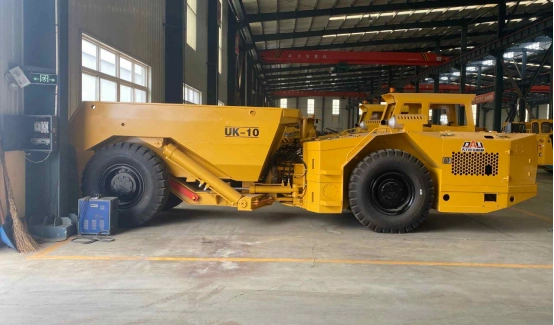
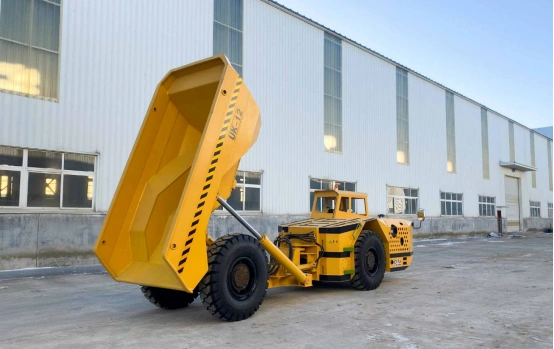
The UK-6 has a 6,000 kg tramming capacity, 3 m³ dump box, 1,540 mm width, and 3,920/5,810 mm turning radii. Those dimensions make it a useful comparison point for small-mine ramps and development drifts. Check the loader unloading height, truck side height, approach angle, and actual tonnes per bucket before approving the pair.
What Equipment Suits Room-and-Pillar Mining?
Room-and-pillar mining uses a network of rooms and supporting pillars in flat or gently dipping deposits. Room and pillar mining equipment must turn around pillars, work through crosscuts, and share travelways with support and service activity.
Capacity Follows Room Dimensions
A small opening may suit a 4 tonne loader and a compact truck. Wider rooms and higher output can support a 10 tonne class with a 4 to 4.5 m³ standard bucket. Measure pillar corners and crosscut entries at full articulation. Add articulation sweep and bucket-corner travel to the roadway-width check.
Traffic Controls Daily Output
Set one-way routes, passing bays, loading pockets, and truck exchange points in the cycle study. A larger truck reduces trip count and occupies more room at intersections. Use actual loaded and empty travel times when comparing underground mining trucks.
How Should Sublevel Stoping Use LHDs and Trucks?
Sublevel stoping breaks ore into larger stopes and draws the muck from loading points below. Sublevel stoping equipment needs bucket capacity, breakout force, and fleet balance that can sustain the planned draw rate.
Medium and Large Loader Classes
A 10 tonne LHD class can use a 4 to 4.5 m³ bucket, while a 14 tonne class can use a 6 m³ bucket. One 14 tonne configuration is specified for roadways above 4.2 × 3.8 m. Use these classes after checking loose density, fragmentation, brow clearance, turn geometry, and dump height.
Truck Capacity and Pass Count
Choose a truck payload that accepts a practical number of full loader passes. Count loading, positioning, truck exchange, loaded travel, dumping, and return. Oversize rock and poor bucket fill stretch the cycle, so include fragmentation and measured fill factor in the study.
What Changes in Sublevel and Block Caving?
Caving methods create repeated loading at drawpoints as broken ore moves under gravity. Block caving haulage depends on steady draw control, fragmentation management, traffic flow, and fast recovery from blocked drawpoints.
Large-Scale Drawpoint Work
The WJ-8 has an 18 tonne tramming capacity, 7.5 m³ bucket, 300 kN breakout force, and 342 kN tractive force. It is specified for 5 × 5 m tunnels and loading 40 to 65 tonne mine trucks. Confirm the 2,854 mm maximum unloading height with a truck-interface drawing.
Congestion and Oversize Control
Check drawpoint spacing, remote-operation zones, secondary breaking access, truck queue length, and escape routes. Large capacity pays through completed cycles. A blocked brow or a truck waiting area with one usable lane can remove that gain quickly.
How Do You Complete LHD Truck Matching?
LHD truck matching starts with effective payload. Calculate effective bucket tonnes = bucket volume × loose density × fill factor. Then divide the truck working payload by effective bucket tonnes to estimate passes.
Confirm the loader dump height, reach, truck side height, approach grade, and loading-bay width. Check braking and tire loads on the full route. The truck and loader should finish their cycles with little waiting at the loading point or dump station.
What Data Belongs in the Fleet RFQ?
Include the mining method, tonnes per shift, loose density, fragmentation, drift dimensions, tightest turn, gradient, haul distance, drawpoint layout, truck interface, ventilation limit, road condition, and required safety documents. Add availability targets, maintenance skills, spare-parts expectations, and remote-control requirements. This data turns a model list into an operating plan.
A Method-Led Fleet Review for Your Mine
DALI covers compact loaders and trucks for narrow workings as well as 10, 14, and 18 tonne LHD classes for larger production duties. Its model specifications connect payloads with bucket sizes, and loader ROPS/FOPS and CE documentation are available.
Send the mining method, roadway profile, production target, material density, haul distance, and receiving-truck data with your enquiry. DALI can use those inputs to review LHD truck matching, clearance, bucket size, dump geometry, and supporting documentation. The result stays tied to the stope and route you plan to operate.
FAQ
Q1: How Do Underground Mining Methods Affect LHD Size?
A: The method sets the excavation shape, loading point, travel route, and production rhythm. Choose an underground mining LHD that clears the full articulated route and carries the required tonnes per completed cycle.
Q2: What Cut and Fill Mining Equipment Fits Narrow Veins?
A: Compact loaders with controlled turning and suitable ground pressure often fit selective headings. A 4 tonne, 2 m³ class provides a useful screening point. Match it with the access width, fill floor, ramp, and receiving truck.
Q3: How Do You Choose Room and Pillar Mining Equipment?
A: Measure room height, pillar corners, crosscuts, passing bays, and travel distance. Select payload from the shift target and cycle time. Check full articulation because repeated turns around pillars affect clearance and output.
Q4: What Controls Block Caving Haulage Capacity?
A: Drawpoint output, fragmentation, oversize handling, loader cycle time, truck queueing, and route availability control capacity. Large loaders need adequate brows, turning room, road strength, ventilation, and recovery access.
Q5: What Information Supports LHD Selection for Underground Mining?
A: Provide underground mining methods, tonnes per shift, loose density, drift geometry, gradient, haul distance, drawpoint layout, dump height, truck payload, ventilation, and safety requirements. These inputs support a fleet review based on the actual mine plan.
About Us
Qixia Dali Mining Machinery Co., Ltd was established in 1998, located in Yantai City.
The company is mainly engaged in the design, development, production, installation and training of underground mine equipment and ore processing equipment, spare parts supply and sales.
More

Contact Us
- Xinbang Rd, Private Economy Park, Qixia, Shandong Province, China
- +86 173 5350 8179
- ytdali@ytdali.com
 +86 13553073459


