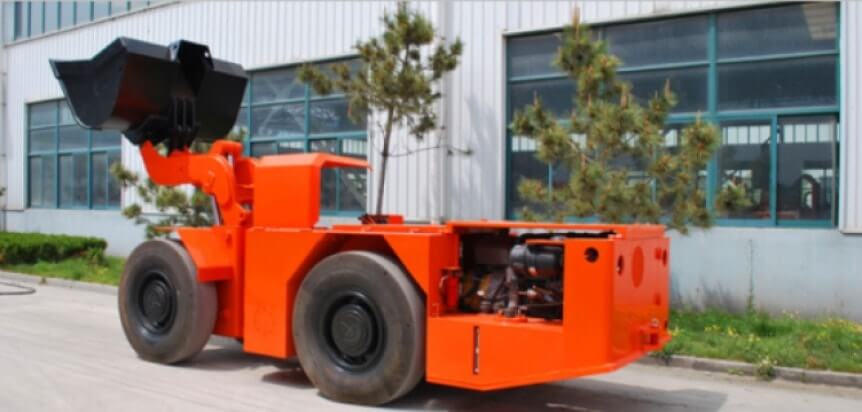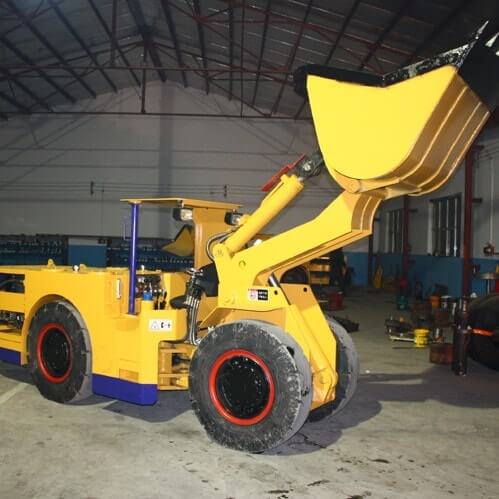
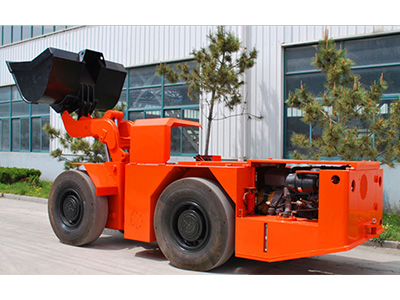
The DALI WJ-1.5 is a compact 3-ton diesel underground LHD loader for mines where access and maneuverability take priority over maximum bucket size. Its published configuration combines a 1.5 m³ bucket, 1,760 mm width, 6,649 mm length and 83 kW Deutz engine. Remote control is listed as available.
|
Selection Item |
Published Value |
|
Rated payload |
3,000 kg |
|
Standard bucket |
1.5 m³ |
|
Overall dimensions (L x W x H) |
6,649 x 1,760 x 2,082 mm |
|
Maximum breakout force |
85 kN |
|
Maximum traction |
104 kN |
|
Engine |
Deutz F6L914, 83 kW at 2,300 rpm |
 Chat With Us
 Leave Message
The WJ-1.5 is positioned between DALI’s smaller narrow-vein loaders and its 4-ton WJ-2. It provides a 3,000 kg rated payload while keeping the published body width at 1,760 mm and overall length at 6,649 mm. This makes it an access-led choice for operations that cannot justify the size and operating weight of a larger production LHD.
The loader uses an articulated frame, rear-mounted side-seated operator position and hydraulic work controls. Selection should begin with the full travel route: the shortest corner, drawpoint approach and dumping area may matter more than the nominal roadway width.
The 3,000 kg payload and 1.5 m³ bucket target mines that need a step up from a small narrow-vein loader but do not require a 4-ton cycle. Match the bucket to loose density so dense ore does not exceed the rated payload before the bucket is visibly full.
Published dimensions are 6,649 x 1,760 x 2,082 mm. Compared with the published WJ-2 data, the WJ-1.5 is 351 mm shorter, 40 mm narrower and 2,500 kg lighter at operating weight. Those differences may be useful where intersections, cage limits, ground pressure or recovery logistics constrain the fleet.
Published figures include 85 kN breakout force, 104 kN traction and speed up to 19.4 km/h. Treat these as selection data, not a production guarantee; achievable cycle time depends on the drawpoint condition, haul profile, traffic, bucket fill and dumping arrangement.
The listed drivetrain combines a Deutz F6L914 rated at 83 kW with a DANA C270 torque converter, RT20000 gearbox and CMG CY-2J rigid planetary axles. Confirm component availability and approved substitutions before using these names in a tender specification.
The published 40° articulation angle and ±8° axle oscillation support movement through uneven, changing headings. Because no turning radius is published, the articulation figure alone should not be used to approve a corner or passing-bay layout.
Four-wheel drive and braking are listed together with a spring-applied, hydraulically released parking-brake arrangement. Ask the supplier to identify service, parking and emergency functions separately and provide the commissioning brake-test procedure for the selected machine.
Remote control can be considered where the loader must enter a drawpoint without an onboard operator. The offer should state which travel and bucket functions are controlled, where emergency stops are located and how the machine responds to communication loss.
Use the most restrictive point on the route, not the average roadway, to assess the WJ-1.5:
Turning radii and bucket width are not published. A quotation should therefore include a configuration-specific drawing overlaid on the mine’s tightest corner and dumping approach.
The WJ-1.5 page lists four-wheel braking, SAHR parking-brake architecture, drivetrain alarms and an exhaust purifier with silencer. The 14,000 kg published laden weight should be used when planning towing, recovery and brake verification.
Commissioning should verify the actual stopping performance, articulation lock, boom support, isolation points and remote-control interlocks. For routine maintenance, prioritize the center joint, bucket linkage, tire condition, hydraulic leaks and warning functions because these directly affect maneuvering in restricted headings.
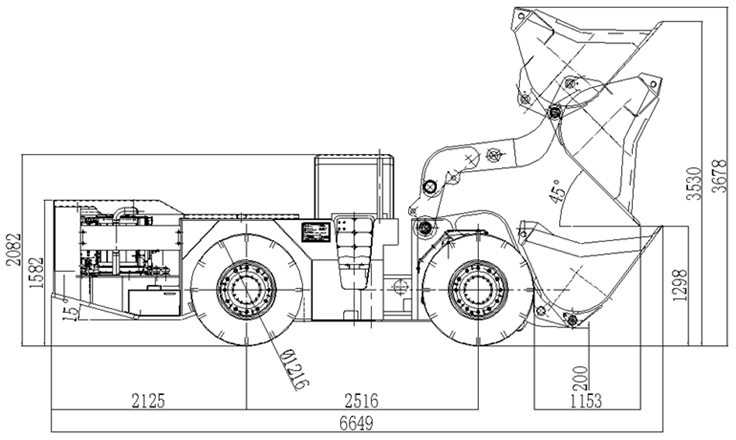
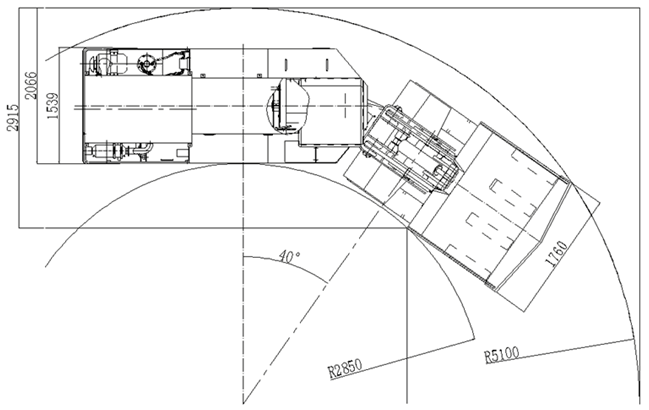
|
Parameter |
Specification |
|
Rated payload |
3,000 kg |
|
Standard bucket |
1.5 m³ |
|
Maximum breakout force |
85 kN |
|
Maximum traction |
104 kN |
|
Published laden gradeability |
20°; confirm test conditions |
|
Maximum published speed |
19.4 km/h |
|
Boom raising time |
≤5.6 s |
|
Boom lowering time |
≤2.5 s |
|
Dumping time |
≤2.9 s |
|
Parameter |
Specification |
|
Overall dimensions (L x W x H) |
6,649 x 1,760 x 2,082 mm |
|
Minimum ground clearance |
200 mm |
|
Maximum lift height |
3,678 mm |
|
Maximum unloading height |
1,298 mm |
|
Steering angle |
40° articulation |
|
Axle oscillation |
±8° |
|
Turning radius |
Not published on current page |
|
Parameter |
Specification |
|
Operating weight |
11,000 kg |
|
Laden weight |
14,000 kg |
|
Empty front axle load |
3,650 kg |
|
Empty rear axle load |
7,350 kg |
|
Loaded front axle load |
7,200 kg |
|
Loaded rear axle load |
Not published on current page |
|
Parameter |
Specification |
|
Published standard engine |
Deutz F6L914 |
|
Engine type |
Air cooled, inline 6 |
|
Rated power |
83 kW at 2,300 rpm |
|
Published alternative engine |
Deutz BF4M1013C; exact designation requires confirmation |
|
Published emission level |
Euro II / Tier 2; confirm destination suitability |
|
Exhaust aftertreatment |
ECS catalytic purifier with silencer, as published |
|
Torque converter |
DANA C270 |
|
Gearbox |
RT20000 |
|
Axle brand / model |
CMG CY-2J |
|
Axle type |
Rigid planetary axle |
Confirm the final bill of materials and standard-versus-optional status in the quotation.
Consider the WJ-1.5 when the published 6,649 mm length, 1,760 mm width or 11,000 kg operating weight provides a useful access advantage and a 3,000 kg payload can still meet the production plan. Choose by route and duty calculation, not model number alone.
The page lists a 3,000 kg payload and 1.5 m³ standard bucket. Divide the payload by expected loose density to estimate the maximum usable volume, then compare it with the bucket capacity and realistic fill factor.
No. The 1,760 mm body width does not include the complete operating envelope. Approval also requires bucket width, tire clearance, articulation sweep, turning radii and the mine’s minimum safety clearance.
The page identifies a Deutz F6L914 rated at 83 kW as the standard engine and mentions BF4M1013C as an option. Confirm the exact engine designation, cooling system, emission level and regional availability in writing.
It may support mucking from an unsupported drawpoint or another location where the mine procedure keeps personnel away from the machine. Confirm the exact control architecture and risk controls before selecting it.
Provide the tightest roadway cross-section, corner geometry, cage or transport limits, drawpoint layout, unloading height requirement, material density, shift target, haul distance and requested remote-control or fire-protection equipment.