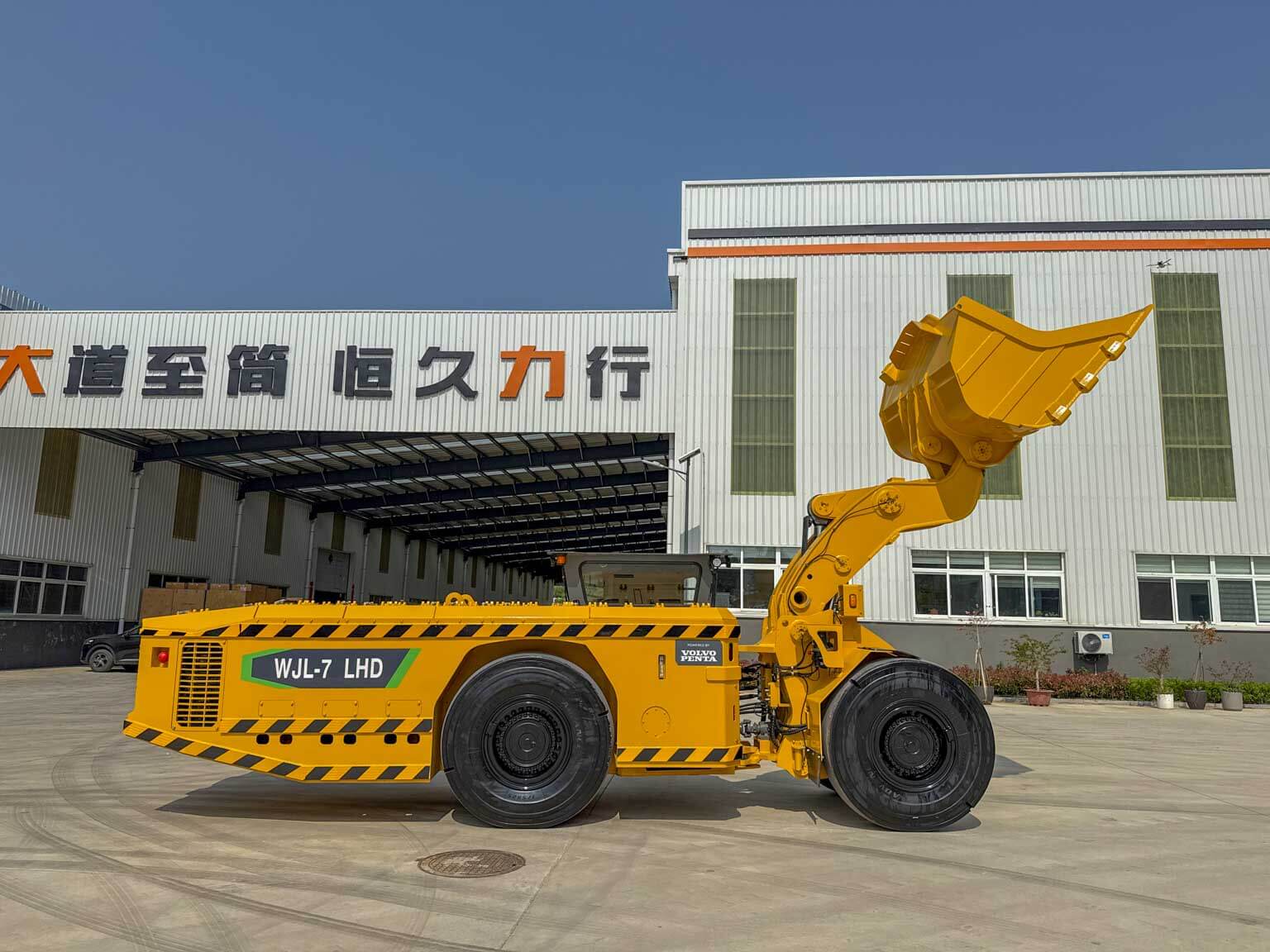
The DALI WJ-3EB is a 7-ton battery electric underground LHD for loading, hauling and dumping ore in mine development and production areas. It pairs a 3.0 m³ bucket with a 282 kWh LiFePO4 battery, external fast charging and a compact 2.1 m machine width. Battery propulsion eliminates diesel exhaust at the point of use and removes trailing-cable restrictions.
|
Specification |
Value |
|
Rated tramming capacity |
7,000 kg |
|
Standard bucket |
3.0 m³ |
|
Usable battery capacity |
282 kWh |
|
Battery chemistry |
LiFePO4 |
|
Minimum published charge time |
0-90% in 1 hour |
|
Overall dimensions (L × W × H) |
9,400 ±100 × 2,100 × 2,270 ±50 mm |
|
Approximate operating weight |
21,000 kg, including battery |
 Chat With Us
 Leave Message
As a battery electric underground LHD, the WJ-3EB is designed for underground material handling. Its 7,000 kg rated payload and 3.0 m³ bucket place it in the medium-capacity range for mine development and production loading.
The onboard battery allows the loader to travel without a trailing power cable. With no diesel engine, the machine produces no diesel exhaust at the point of use. Actual ventilation, heat-load and charging requirements must still be assessed for the complete underground operation.
The rated 7,000 kg tramming capacity and standard 3.0 m³ bucket provide a practical combination for medium-scale underground loading. Final bucket selection should account for loose material density, fragmentation, fill factor and the mine’s truck or ore-pass interface.
The published battery system provides 282 kWh of usable capacity and uses LiFePO4 chemistry. Liquid cell cooling and an integrated thermal-management system are listed to manage battery temperature during operation and charging.
The page lists an external charger and a minimum charge time of one hour from 0% to 90%. This gives planners a starting point for scheduling charging windows, but charger power, mine input voltage, charging-bay design and real cycle time must be confirmed for each project.
Unlike a tethered electric LHD, the onboard battery does not require a trailing cable during loading and tramming. This supports movement between headings and haulage points while avoiding diesel exhaust at the machine.
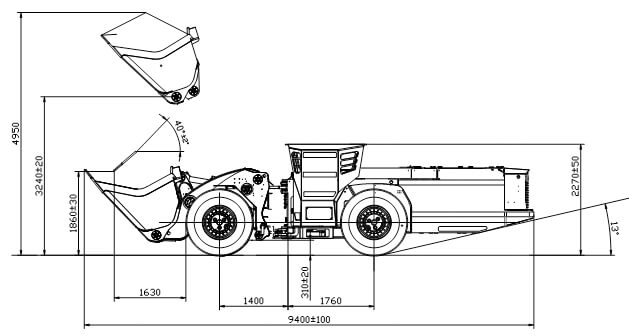
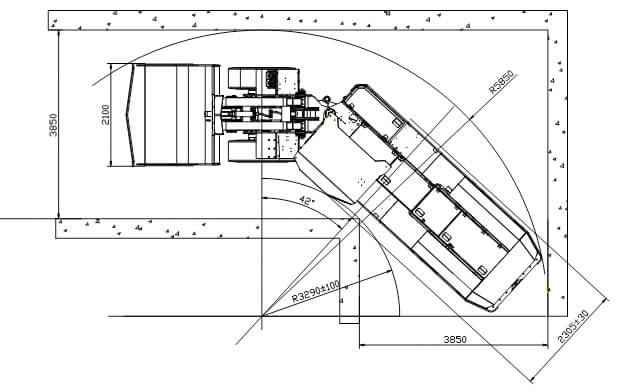
Published drawings show an overall length of approximately 9,400 mm, width of 2,100 mm and height of 2,270 mm. The indicated inner and outer turning radii are approximately 3,290 mm and 5,850 mm, helping buyers check bends, intersections and loading areas before ordering.
The current specification lists separate traction and auxiliary electric-drive functions, both liquid cooled. This arrangement allows propulsion and hydraulic work functions to be powered independently; final motor ratings and component brands require engineering confirmation.
Boom raising, lowering and dumping times are listed as 5.0, 3.3 and 3.3 seconds respectively. These figures help compare machine configurations, although actual cycle output will depend on route, gradient, material, bucket fill, operator practice and charging strategy.
Before requesting a quotation, provide the roadway profile, minimum width and height, gradient, corner radii, travel distance and loading/dumping layout. Also provide material density, fragmentation, target tonnes per shift and the receiving truck, crusher or ore-pass dimensions.
For the battery system, confirm duty cycle, available charging windows, charging-bay location, mine electrical supply, ambient temperature and whether the project needs an additional battery or off-board battery arrangement. The published operating-temperature range is 0-40°C; applications outside this range require written approval.
The published specification lists LiFePO4 chemistry, liquid battery cooling and integrated thermal management. It does not provide enough detail to establish market-specific compliance or the complete high-voltage safety package.
Before purchase, confirm battery isolation, emergency shutdown, charging interlocks, fire detection or suppression, towing and recovery procedures, operator protective structure, brake configuration, maintenance lockout, charger certification and local mine approval requirements. Battery warranty, expected cycle life and end-of-life handling should also be documented in the quotation.
|
Parameter |
Specification |
|
Rated tramming capacity |
7,000 kg |
|
Standard bucket |
3.0 m³ |
|
Boom raising time |
5.0 s |
|
Boom lowering time |
3.3 s |
|
Dumping time |
3.3 s |
|
Parameter |
Specification |
|
Overall length |
9,400 ±100 mm |
|
Overall width |
2,100 mm |
|
Overall height |
2,270 ±50 mm |
|
Inner turning radius |
3,290 ±100 mm |
|
Outer turning radius |
5,850 mm |
|
Articulation angle |
42° |
|
Reference roadway width shown in drawing |
3,850 mm |
|
Rear departure angle shown in drawing |
13° |
|
Parameter |
Specification |
|
Approximate empty-machine weight, including battery |
21,000 kg |
|
Front axle load |
9,240 kg |
|
Rear axle load |
11,760 kg |
|
Published battery-pack weight |
2,200 kg |
|
Parameter |
Specification |
|
Battery chemistry |
LiFePO4 |
|
Usable battery capacity |
282 kWh |
|
Cell cooling |
Liquid cooled |
|
Thermal-management system |
Integrated |
|
Published operating ambient temperature |
0-40°C |
|
Charging source |
External charger |
|
Onboard battery with off-board charger |
Listed as available |
|
Off-board battery arrangement |
Listed as optional |
|
Minimum published charging time |
0-90% in 1 hour |
|
Parameter |
Specification |
|
Axle |
Kessler D91, as published |
|
Tire size |
17.5 R25, slick or treaded |
Tire selection should be confirmed with the tire supplier based on mine floor conditions, gradient, load, speed and route length.
LHD means load-haul-dump. The machine loads broken material into its bucket, hauls it through underground roadways and dumps it at a transfer point, ore pass, stockpile or truck.
No. The current specification describes an onboard battery with external charging. This allows the loader to travel without a trailing power cable during operation.
The published minimum is one hour from 0% to 90%. Actual time depends on the approved charger, electrical supply, battery temperature and charging controls. Confirm charger input and output ratings before planning the charging infrastructure.
The current page does not publish a verified runtime. Runtime will vary with payload, route length, gradient, travel speed, hydraulic use, temperature and idle time. Send a representative duty cycle so DALI can check the battery and charging plan.
No. Battery propulsion removes diesel exhaust at the machine, but mine ventilation must still address blasting fumes, dust, heat, people and other equipment in accordance with the site’s ventilation design and regulations.
Send the roadway profile, route length, gradient, material density, target tonnes per shift, loading and dump-point layout, charging windows, available electrical supply, ambient temperature, destination country and required safety package.